What happens on a driving test follows four parts. You read a number plate, answer two vehicle safety questions, drive for around 35 minutes including independent driving, and complete one reversing exercise. You pass with no more than 15 driving faults and no serious or dangerous faults.
Key takeaways
- Take your UK photocard driving licence and a suitable car. Your test can be cancelled, with no refund, if you do not.
- The test is the same for manual and automatic cars, and does not include motorways.
- Your examiner makes notes throughout. Notes do not mean you have made a mistake.
- You can ask your instructor to sit in the back. They cannot help during the test.
- Test routes are not published, so practise the types of roads around your test centre.
What should you take to a driving test?
You must take your UK photocard driving licence, your theory test pass certificate if you have it, and a car. The DVSA does not provide a car. Arrive at the test centre 5 minutes before your appointment.
If you lose your licence, apply for a replacement straight away. It can take up to 15 days to arrive, so rearrange your test if it will not be there in time. Your test will be cancelled and you will not get a refund if you do not take the right things.
Most learners use their instructor’s car, which is already prepared for the test. If you would rather use your own car, it must meet the DVSA rules, which are listed in the FAQ below. If you need a car for the test, see our driving test car hire page.
On driving test day, eat something, drink some water and allow extra time for traffic and parking.
What are the four parts of the test?
The test lasts around 35 minutes and has four parts. It is the same for manual and automatic cars.
| Part | What happens |
|---|---|
| 1. Eyesight check | You read a number plate before you start driving. If you fail, the test ends. |
| 2. Show me, tell me | One “tell me” question before you drive and one “show me” question while you drive. |
| 3. General driving | You drive on a range of roads and in different traffic, but not on motorways. This includes independent driving. |
| 4. Reversing | You complete one of three reversing exercises. |


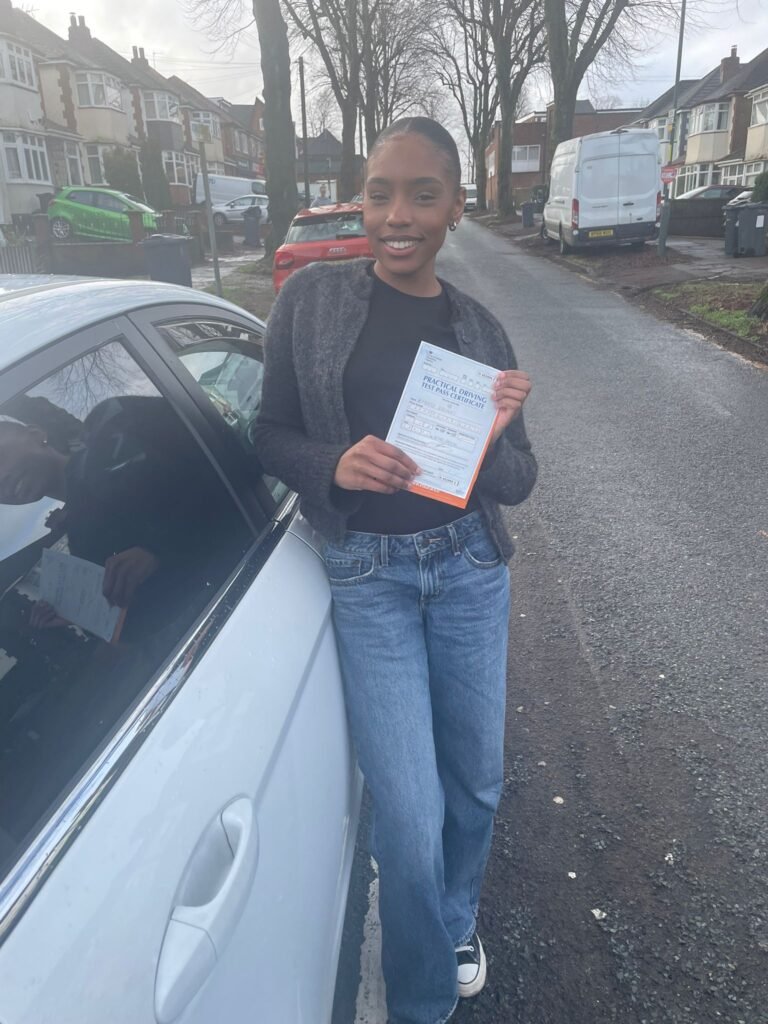
The driving test eyesight check
You read a number plate from 20 metres if it is a new-style plate, or 20.5 metres if it is an old-style plate. New-style plates start with two letters followed by two numbers, such as AB51 ABC. Wear your glasses or contact lenses if you need them to drive. If you fail the eyesight check, the test ends.
Show me, tell me questions
You are asked two vehicle safety questions. The “tell me” question comes at the start, before you drive. You explain how you would carry out a safety task. The “show me” question comes while you are driving. You show how you would carry out a safety task.
If you get one or both questions wrong, you receive one driving fault. The DVSA publishes the full list of show me, tell me questions. Practise them with your instructor until you can answer without hesitating.
Driving test independent driving
For 20 to 35 minutes, you drive independently. You follow a sat nav, traffic signs, or a combination of both, and the examiner tells you which. The examiner sets up the sat nav for you, and you cannot use your own. When you are not following a sat nav or signs, the examiner gives you turn-by-turn directions.
Reversing
The examiner asks you to do one of three exercises:
- Parallel park at the side of the road.
- Park in a bay, either driving in and reversing out or reversing in and driving out. The examiner tells you which.
- Pull up on the right-hand side of the road, reverse for around two car lengths, then rejoin the traffic.
Who can sit in the car with you?
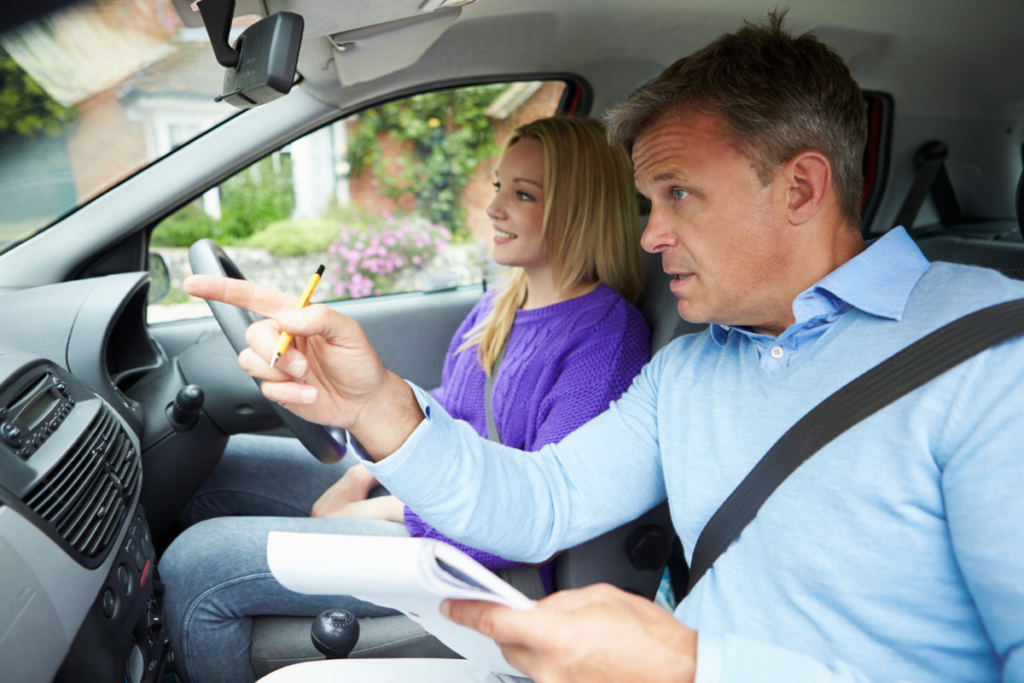
You can ask your instructor to sit in the back of the car. They can watch and make notes, but they cannot give you any help. The DVSA encourages this because the feedback at the end is short and hard to remember when you are excited or disappointed. Some learners also find they are calmer with someone they know in the car.
Your instructor can also listen to the examiner’s feedback at the end, even if they did not sit in. Tell your instructor before the test whether you would like them there. According to gov.uk, your examiner’s supervisor may also sit in occasionally to watch the examiner at work.
How many faults can you make on a driving test?
You can make up to 15 driving faults and still pass, as long as you make no serious or dangerous faults. The examiner records faults in three categories:
| Fault type | What it means | Effect |
|---|---|---|
| Driving fault | Not potentially dangerous, but repeating it could make it serious. | Up to 15 allowed |
| Serious fault | Something that has the potential to be dangerous. | Fails the test |
| Dangerous fault | Involves actual danger to you, the examiner, the public or property. | Fails the test |
The examiner makes notes throughout the test, including marking that you have done certain parts. If you see them writing, do not assume you have made a mistake. Stay focused on your driving. Our guide to common driving test mistakes and how to avoid them shows what examiners most often record.


What should you do if you make a mistake?
Carry on driving safely. You can continue after a mistake, and it might not affect your result if it is not serious. The examiner only stops the test if they think your driving is a danger to other road users.
Dwelling on a mistake is what turns one fault into several. Take a breath, check your mirrors and focus on the next junction.
What happens at the end of the test?
Your examiner tells you whether you have passed and explains any serious or dangerous faults. You also receive an email with your result. The email shows how many faults you made and what they were about, but not where you made them. This is why having your instructor listen to the feedback helps.
- If you pass, you can start driving straight away. You must have insurance that allows you to drive without supervision. Check gov.uk for how to get your full licence.
- If you do not pass, the examiner tells you what faults you made. You have to book another test and pay again. Use the feedback to plan your next lessons.
What is different about test day in Birmingham?
Test routes are not published, so no one can tell you the exact roads you will drive. What you can do is practise the types of roads, junctions and roundabouts around your test centre.
Birmingham has several driving test centres, including Shirley, Kings Heath, Kingstanding, Garretts Green and South Yardley. Ask your instructor to include the kinds of roads you are likely to meet near your centre. Our complete guide to Birmingham driving test routes is a useful companion read.
Booking rules also changed in 2026. You now book and manage your own test, so an instructor cannot book it for you. You can change a booking only twice, and moving your test to another centre is limited to the three centres nearest to where it is booked. It is free to change your appointment time if you do so at least 10 full working days before your test. Check gov.uk for the latest.
Because changes are limited, book when your instructor agrees you are consistent.
FAQ
Can I use my own car for the driving test?
Yes, if it meets the DVSA rules. The car must be taxed, insured for a driving test, roadworthy and have a current MOT if it is over three years old. It must have L plates on the front and back that do not block anyone’s view, and two rear view mirrors, with one fitted for the examiner. No warning lights can be lit on the dashboard, and all headlights, brake lights and indicators must work. Tyres must have legal tread and no damage, and both front seat belts must work. Check the full rules on gov.uk. You will not be allowed to take the test, and will not get a refund, if the car does not meet them.
Is the driving test different in an automatic car?
No. The test is the same for manual and automatic cars. If you pass in an automatic, your licence only allows you to drive automatic cars. Check gov.uk for the latest.
Will I drive on a motorway during the test?
No. You drive in various road and traffic conditions, but not on motorways.
Can I move my driving test if I do not feel ready?
Yes, within the limits above. It is free to change your appointment time at least 10 full working days (Monday to Saturday) before your test, and you can make two changes in total. Speak to your instructor before you decide.

Get ready for your test
Call us on 07785 602008 or send the booking form. See our driving lessons in Birmingham page for areas and details, or read about learning to drive in Shirley if you plan to test there.