
Learning to drive is becoming a significant expense for many people across Birmingham. As the cost of professional driving tuition rises, learners are increasingly looking at driving lesson prices, intensive courses and the other costs involved in getting a full UK driving licence.
The price of a driving lesson can vary depending on the instructor, location, type of vehicle and course. However, the latest figures from the Driver and Vehicle Standards Agency (DVSA) show that £36 to £40 is currently the most common price range for a one-hour driving lesson in Great Britain. In the West Midlands, which includes Birmingham, 48.9% of instructors reported charging between £36 and £40 per hour, while 14.1% charged £41 or more.
So, why are driving lessons becoming more expensive, and what should Birmingham learners expect to pay?
How Much Are Driving Lessons in Birmingham?
There is no single price for driving lessons in Birmingham. Individual instructors and driving schools set their own rates, and prices can differ according to the type of lesson and the instructor’s availability.
The latest DVSA survey of Approved Driving Instructors provides a useful picture of current UK pricing. In October 2025, 50.3% of instructors charged between £36 and £40 for a one-hour lesson. A further 22.5% charged £41 to £45, while 5% charged £46 to £50.
The West Midlands remains one of the regions where lower and mid-range prices are relatively common. According to the same survey, 37% of instructors in the region charged £35 or less, 48.9% charged £36 to £40, and 14.1% charged £41 or more.
This means Birmingham learners may find a range of prices when comparing instructors. The cheapest option is not necessarily the most cost-effective if the learner needs considerably more lessons to reach test standard.
Why Are Driving Lesson Prices Increasing?
Several factors can contribute to higher driving lesson prices.
Driving instructors have substantial business costs. Unlike employees with a fixed salary, self-employed instructors generally need to cover their own vehicle costs, fuel, insurance, servicing, maintenance, road tax and other business expenses.
The vehicle used for teaching also has to cope with significantly more mileage than a typical private car. Frequent stopping, starting, manoeuvring and use by different learners can contribute to wear and maintenance requirements.
Insurance is another important consideration. Driving instructors need appropriate cover for providing professional tuition, and insurance costs can affect the price they need to charge.
Fuel and general operating costs can also influence lesson prices. When the cost of running a driving school increases, instructors may need to adjust their hourly rates to keep the business viable.
Instructor Availability Can Also Affect Prices
Supply and demand can influence driving lesson prices.
The DVSA’s 2025 survey found that 45.4% of Approved Driving Instructors had availability to take on new pupils. This was an improvement compared with the previous survey, but availability still varies between locations and instructors.
In areas where learners are competing for a limited number of instructors, prices can be higher. Popular instructors may also have waiting lists, particularly when demand increases around periods when young people are looking to learn to drive.
This is one reason why learners should compare several instructors rather than assuming that every driving school in Birmingham charges the same amount.
Current Driving Course Prices at Learner Driving School
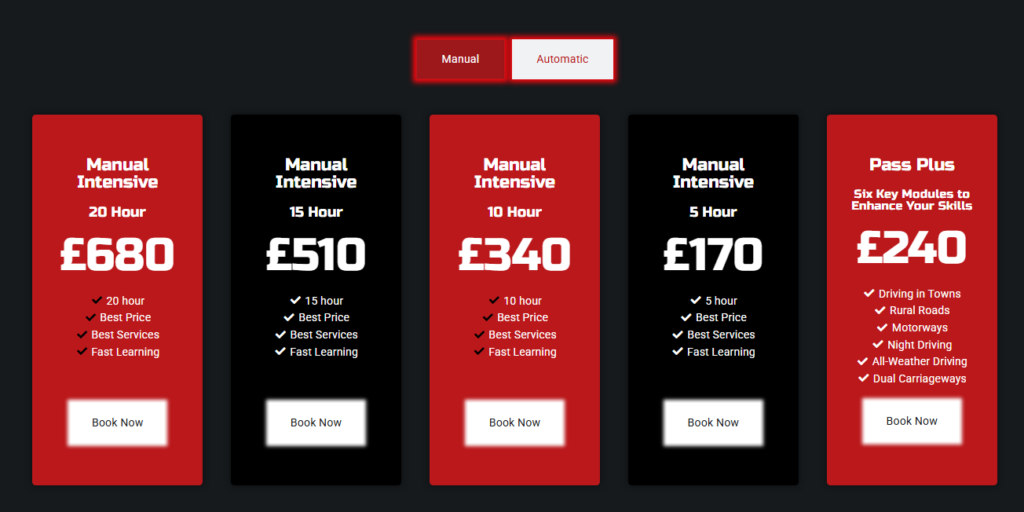
For learners looking for structured training in Birmingham, Learner Driving School currently lists intensive driving courses for both manual and automatic cars.
Its current pricing page lists:
| Course | Hours | Price |
|---|---|---|
| Manual Intensive | 5 hours | £170 |
| Manual Intensive | 10 hours | £340 |
| Manual Intensive | 15 hours | £510 |
| Manual Intensive | 20 hours | £680 |
| Automatic Intensive | 5 hours | £170 |
| Automatic Intensive | 10 hours | £340 |
| Automatic Intensive | 15 hours | £510 |
| Automatic Intensive | 20 hours | £680 |
| Pass Plus | Six modules | £240 |
These prices are listed on Learner Driving School’s current pricing page and should be checked again before booking because driving school prices can change.
The school’s current Birmingham service also covers areas including Birmingham, Handsworth, Small Heath, Kings Heath and Perry Barr.
How Much Does It Cost to Learn to Drive?
The total cost depends heavily on how many lessons a learner needs.
The DVSA states that most learners require around 45 hours of professional instruction combined with around 22 hours of private practice to reach the standard needed to pass the practical test. However, this is not a fixed requirement. Some learners need fewer hours, while others require considerably more.
At £40 per hour, for example, 45 hours of professional tuition would cost £1,800.
At £45 per hour, the same 45 hours would cost £2,025.
This demonstrates why even a relatively small increase in the hourly lesson price can make a noticeable difference to the overall cost of learning to drive.
Private practice can potentially reduce the number of professional lessons required, provided it is carried out legally, safely and with a suitable supervising driver and appropriately insured vehicle.

Don’t Forget the Cost of the Driving Tests
Driving lessons are only one part of the total expense.
For a car learner in Great Britain, the current official fees include:
| Expense | Current official fee |
| Provisional driving licence | £34 online / £43 by post |
| Car theory test | £23 |
| Practical car test – weekday | £62 |
| Practical car test – evening, weekend or bank holiday | £75 |
These are the official DVSA fees. A learner who fails a test and books another test has to pay the relevant test fee again.
Learners should also consider other potential costs, such as additional lessons before a retest, use of an instructor’s car for the practical test and private practice costs.
Birmingham Learners Also Need to Consider Test Waiting Times
Driving test availability is another important factor when planning the cost of learning to drive.
The DVSA introduced more detailed driving test waiting-time information in 2026. The new data includes the median time between booking a practical test and taking it, as well as information about test availability at individual centres.
Nationally, the median waiting time for a car practical test was 9.7 weeks in May 2026. However, waiting times vary substantially between test centres.
For Birmingham learners, this can make planning more complicated. A learner who is ready for a test may still have to continue practising while waiting for an appointment. Equally, booking a test too early could mean paying for additional lessons over a longer period while waiting to reach the required standard.
The latest DVSA waiting-time dataset available before this article’s publication was updated in July 2026 with data covering June 2026. This is why learners should check the latest information rather than relying on older figures or general claims about a 24-week waiting period.
Does an Intensive Driving Course Cost Less?
An intensive course does not automatically mean that learning to drive will cost less.
The main advantage is that lessons can be concentrated into a shorter period. This can be useful for learners who have a deadline, have already completed some training or prefer a structured approach.
However, the number of hours required should be based on the learner’s ability and progress rather than simply choosing the cheapest package.
For example, Learner Driving School currently offers 5-, 10-, 15- and 20-hour intensive packages at £34 per hour.
A learner who needs substantially more training may need additional tuition after completing the package. Therefore, the overall cost should be considered rather than looking only at the initial package price.
How Can Birmingham Learners Keep Costs Under Control?
There are several practical ways to manage the cost of learning to drive.
Practise Between Lessons
If you have access to a suitable car and a qualified supervising driver, private practice can give you more time behind the wheel without paying an instructor for every hour.
Take Lessons Regularly
Long gaps between lessons can make it harder to retain skills. Regular training can help maintain progress and make professional lesson time more productive.
Compare Instructors
Do not compare instructors on hourly price alone. Consider availability, experience, lesson duration, vehicle type and whether the instructor’s teaching style suits you.
Prepare for Your Test
Being properly prepared before taking the practical test can reduce the risk of paying for repeated test fees and additional lessons after an unsuccessful attempt.
Consider Block or Intensive Packages
Where a reputable school offers a discount or structured package, booking several hours together may provide better value than paying for individual lessons.
Choosing Driving Lessons in Birmingham
Price is an important consideration, but it should not be the only factor when choosing a driving instructor.
A good instructor should help you develop safe driving habits, understand the rules of the road and become confident in different traffic conditions. Birmingham learners may need to deal with busy junctions, roundabouts, multi-lane roads, changing speed limits, pedestrians and heavy traffic during their training.
The right instructor should therefore focus on your actual progress rather than simply completing a set number of lessons.
Learner Driving School offers manual and automatic driving lessons in Birmingham, as well as intensive driving courses for learners who want a more concentrated training schedule. Its current published packages range from 5 to 20 hours, with both manual and automatic intensive courses listed at the same prices.
What Should Birmingham Learners Expect to Pay?
Driving lesson prices in Birmingham are not fixed, but the latest DVSA data provides a useful benchmark. In October 2025, the most common hourly price across Great Britain was £36 to £40, while almost half of instructors in the West Midlands were also within this range.
At the same time, some instructors and specialist driving schools charge significantly more, particularly for premium, intensive, evening or weekend tuition.
The important point is that the hourly price is only one part of the total cost. The number of lessons required, private practice, test fees and potential retests can all affect the final amount.
Learning to drive in Birmingham has become a significant financial commitment, but careful planning can help learners manage the expense.
Current DVSA data shows that £36 to £40 is the most common hourly lesson price across Great Britain, while prices in the West Midlands cover a broader range. Rising vehicle running costs, fuel, insurance, maintenance and business expenses can all contribute to instructors increasing their rates.
For learners, the best approach is to compare the complete cost of training rather than choosing an instructor based solely on the cheapest hourly rate.
With regular lessons, appropriate private practice and proper preparation for the theory and practical tests, learners can make better use of their training time and work towards becoming safe, confident drivers.