

Learning to drive takes practice, consistency and the right guidance. For some learners, spreading lessons over many weeks can make progress feel slow, particularly when long gaps between sessions make it harder to remember what was covered previously. Intensive driving courses Birmingham offer a more structured approach.
By concentrating lessons into a shorter period, learners can practise the same skills regularly, identify weaknesses sooner and build confidence through continuous experience. For learners preparing for a driving test in Birmingham, this approach can be particularly useful when combined with professional instruction and local road experience.

What Is an Intensive Driving Course?
An intensive driving course involves completing a larger number of driving lessons over a shorter timeframe rather than taking one lesson each week.
The exact structure depends on the learner’s current ability, available time and test readiness. A course may involve several hours of training across consecutive days, allowing the instructor to build each session around the progress made previously.
Intensive training can be suitable for:
- Beginners starting their driving journey
- Learners who already have some experience
- Drivers returning to training after a long gap
- Learners preparing for an upcoming practical test
- People with limited time who prefer concentrated training
An intensive course does not mean rushing a learner through the process. The objective is to use consistent practice to develop the skills required for safe, independent driving.
Why Regular Practice Can Speed Up Progress
Driving involves several skills that need to work together. Steering, clutch control, speed management, observation, signalling and decision-making become easier when they are practised consistently.
With weekly lessons, a learner may have several days between sessions. An intensive course reduces those gaps, meaning the learner can revisit a skill while it is still familiar.
For example, if a learner struggles with busy junctions on Monday, the instructor can work on the same issue again on Tuesday and gradually introduce more complex situations as confidence improves.
This creates a continuous learning cycle:
Practise → receive feedback → correct mistakes → practise again → build confidence

Building Confidence Through Continuous Training
Confidence comes from experience rather than simply completing a certain number of lessons.
Intensive driving courses allow learners to experience different road conditions within a shorter period. Instead of spending several weeks working towards the same level of confidence, learners can progressively move from quieter roads to busier routes as their ability develops.
For people taking driving lessons in Birmingham, this can include exposure to busy junctions, multi-lane roads, roundabouts and changing traffic conditions.
The instructor can gradually increase the difficulty without moving ahead before the learner is ready.

Learning Birmingham Roads and Test Routes
Local road knowledge can be valuable when preparing for a practical test. Learners taking driving lessons in Birmingham can benefit from training on the types of roads and junctions they are likely to encounter during their preparation.
Working on Birmingham driving test routes can help learners become familiar with different traffic patterns, road layouts, roundabouts and common decision-making situations.
Training can also be arranged around different parts of the area, including driving lessons in Solihull, Alum Rock, Digbeth, Small Heath, Hall Green, Birmingham city centre, Bordesley and Balsall Heath.
Learners may also need experience in areas such as Acocks Green, Ladywood Birmingham, the Jewellery Quarter and surrounding parts of the city.
The aim is not simply to memorise a route. A good instructor helps learners understand how to deal with unfamiliar roads and changing situations so that their skills remain useful beyond the test.

Identifying Weaknesses Earlier
One advantage of concentrated training is that weaknesses become easier to identify.
If a learner repeatedly struggles with:
- Roundabout positioning
- Junction decisions
- Mirror use
- Manoeuvres
- Speed control
- Lane discipline
the instructor can address the problem across multiple sessions instead of waiting a full week before reviewing it.
This allows training to be adapted as the learner progresses. A skill that initially requires considerable attention can gradually become part of the learner’s normal driving routine.

Intensive Courses and Driving Lesson Prices
The number of lessons required varies from learner to learner, so there is no fixed number of hours that guarantees test readiness.
Driving lesson prices in Birmingham can also vary depending on the instructor, course structure and number of hours booked. Choosing an intensive package can make it easier to plan the overall training schedule and budget in advance.
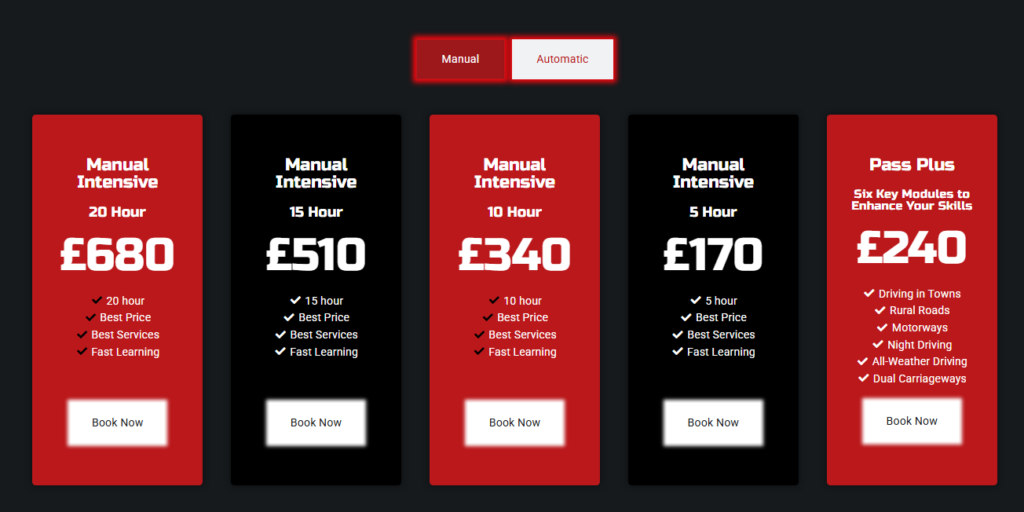
At Learner.co.uk, current automatic and manual intensive course prices are structured as follows:
| Intensive Course | Hours | Price |
|---|---|---|
| Intensive Driving Course | 5 hours | £170 |
| Intensive Driving Course | 10 hours | £340 |
| Intensive Driving Course | 15 hours | £510 |
| Intensive Driving Course | 20 hours | £680 |
| Pass Plus | 6 modules | £240 |
The Pass Plus course covers town driving, rural roads, motorways, night driving, all-weather driving and dual carriageways.
These options give learners flexibility to choose a training structure that fits their experience, availability and learning needs.
Preparing for the Practical Test
An intensive course can be particularly useful when a learner is approaching their test. Rather than spending individual lessons revisiting unrelated skills, the instructor can focus on the areas that still need improvement.
Preparation can include general road driving, manoeuvres, independent driving, hazard awareness and the type of decision-making expected during the practical test.
Learners should not book a test simply because they have completed a certain number of hours. The important question is whether they can drive safely and independently to the required standard.
Making the Most of an Intensive Course
The learner’s approach also affects how much they gain from concentrated training.
Arriving prepared, listening carefully to instructor feedback and taking time to understand mistakes can make each session more productive. Learners should also avoid treating intensive training as a shortcut that replaces proper practice.
The purpose is to create more opportunities to practise correctly and build reliable driving habits.

Why Choose Learner.co.uk for Intensive Training?
Learner Driving School provides structured driving courses designed around the learner’s progress rather than simply completing hours behind the wheel.
Whether you need driving lessons in Birmingham, training around Solihull or lessons in areas such as Digbeth, Small Heath, Hall Green, Acocks Green or Birmingham city centre, professional instruction can help you develop the skills needed for independent driving.
With structured training and regular practice, learners can make better use of their time, build confidence and work towards their test with a clearer understanding of what they need to improve.
Intensive driving courses can help learners progress faster because they create consistency. Skills are practised more frequently, mistakes can be addressed sooner and confidence can develop through continuous experience.
For learners preparing for a driving test in Birmingham, combining intensive training with professional instruction and experience across different local roads can provide a focused route towards test readiness.
The goal is not simply to pass quickly. It is to become a safe, confident and independent driver with skills that continue to be useful long after the test.